Friday, February 28, 2020

Yakutia

The Yakutia Wilderness is envisioned along the East Siberian Arctic coast and upon the off shore islands. It would stretch east from beyond the Lena River Delta on the west to the Kalyma River in the east - approximately 1500 kilometers. The included lands are primarily mossy tundra, rising into mountains to the south. Natural corridors would connect this great wilderness to tundra to the west and east and to the boreal forest to the south.

This wilderness is visualized as a home for a wide assortment of megafauna that can thrive in an arctic environment - similar to the Pleistocene Park envisioned by Sergey A. Zimov and described in a 2005 Science article. Beside wildlife currently extant in these lands, the wilderness would include representatives of pleistocene fauna found elsewhere as well as recreations of extinct megafauna such as the woolly mammoth and woolly rhinocerous.


The table below lists wildlife inhabitants proposed to act as stand-ins for Pleistocene creatures that are now extinct. The modern representatives are either closely related genetically or would play a similar ecological role.

Click chart below and expand to make readable.


Most symbolic of these now extinct animals is the Woolly Mammoth, dwarf representatives of which survived on Wrangel Island for thousands of years after the Pleistocene era ended. Recreation of hairy Pleistocene species is not the fantasy that many people might imagine. 

From mural depicting a herd walking near the Somme River in France
From mural by Charles R. Knight, 1916

As pointed out by Richard Dawkins in The Ancestor's Tale, "Hairiness is one of those characteristics that can increase or decrease in evolution again and again. Vestigial hairs, with their associated cellular support structures, lurk in even the barest-seeming skin, ready to evolve into a full coat of thick hair at short notice... Look at the woolly mammoths and woolly rhinoceroses that rapidly evolved in response to the recent ice ages in Eurasia."

The return of the Pleistocene megafauna presages the renewal of the tundra steppe, the grasslands associated with and maintained by these great creatures. Without such renewal, the carbon now sequestered in the soils of the mammoth ecosystem could end up as greenhouse gases released into the atmosphere by rising temperatures, surpassing the total carbon content of all the planet's rain forests. Restored Pleistocene grasslands could stabilize the soil and prevent permafrost from melting.

The feeding habits of the megafauna could also prevent the growth of shrubs in the tundra and the movement of the boreal forest further north. Widespread shrub and tree expansion, by absorbing more of the sun's heat, could further magnify atmospheric heating over Arctic lands.

The Pleistocene Megafauna Chart below presents some of these Pleistocene species that may have inhabited the area of the proposed Yakutia Wilderness. Those species with a darker gray background are extinct.

Click chart below and expand to make readable.


Thursday, February 27, 2020

Trans-Pecos

Desert Bighorn Sheep
If there is one word that would describe Texas wild lands today, it would be exotic. Texans has an affinity for exotic animals, especially deer and antelope, that are not native to the state. From 1963 to 1994, the exotic population in Texas grew from about 14,000 animals of 13 species to more than 195,000 animals and 71 species. 

The chart below lists six exotic animals now roaming free in the state in such numbers that they must be considered permanent additions to the mammal fauna according to The Mammals of Texas by David J. Schmidly. According to the chart, Texas' record for preserving exotic species seems to lean toward those least in need of help. None of the species fall within the two categories most vulnerable to extinction: (1) critically endangered and (2) endangered. Only one is included within the third most concerned category: vulnerable.

Click chart below and expand to make readable.


There are cases where ranchers have benefited endangered animals from elsewhere. The price, however, has been hunting, which the ranchers say is necessary to pay for the upkeep of the rest of the animals. This has been controversial. 

Envisioned Wilderness


Addax Antelope
This wilderness, envisioned as located in the Trans-Pecos region of West Texas and a portion of New Mexico, would be populated with antelope and other animals that can thrive in this hot and dry climate.

The satellite view Above shows the proposed wilderness area with orienting geographic features and cities. Prospective wildlife corridors are also indicated. The wilderness would be connected to other natural areas such as Mexico's Sierra Madre, the Canyonlands, High Plains, and the Edwards Plateau via these wildlife corridors.

Mountain Nyala Antelope
Emphasis would be on species that are truely endangered and will not out-compete native species. Predators that can cull out weaker creatures and keep numbers within the capacity of the natural environment would also be included.

Animals proposed for inclusion in this wilderness are indicated in the chart below. Exotic species (not either native, previous occupants of area, or naturalized) are in italics and a darker gray background, with their endangered status indicated. All the exotic animals are in one of the four most endangered categories (CR, EN, VU & LR) or are extinct in the wild (EW) according to the IUCN.

Click chart below and expand to make readable.


Tuesday, February 25, 2020

Pantanal Wilderness

The Pantanal is one of the largest and most spectacular freshwater ecosystems in the world, with an exceptionally high biodiversity. It is located south of the Amazon basin, at the crossroads of Bolivia, Brazil, and Paraguay. It covers an estimated area of 175,000 square kilometers, about half the size of California. Numerous distinct ecological systems exist within its confines. 


Tributaries of the Paraguay River flood and recede every year, rhythmically transforming the region from floodplains to grassy savannahs. In addition to critical habitats for a diverse and highly concentrated array of vegetation and wildlife, the Pantanal’s hydrological system supports and provides certain invaluable ecosystem services to local communities, such as water purification, nutrient storage, sediment trapping, flood control, storm protection, and climate stabilization.

Located in the center of South America, the Pantanal forms a link between the biomes of the Amazon, the Cerrito savannah and the Chacos of Bolivia and Paraguay. The region lies at an altitude of less than 150 meters and the landscape is virtually flat. During the rainy season up to 80% of the territory is inundated, forcing out most of the local population, who temporarily migrate to the surrounding towns and villages. Beyond rivers and various forests, the Pantanal is a complex system of marshlands, floodplains, lagoons and interconnected drainage channels.

Brazilian Tapir
There is a fear that the Pantanal wetland may disappear by 2050. According to Conservation International, deforestation in the Brazilian Pantanal has quadrupled in recent years. Already,17 percent of the original vegetation has been lost in the region.

The envisioned wilderness would encompass most of this marsh land as well as some adjoining uplands. The proposed Pantanal Wilderness is shown below in a satellite view of the earth. The location of the Bolivian Altiplano and the cities of Santa Cruz, Cuiaba and Campo Grande provide for orientation of the viewer. Wildlife corridors would connect it to the Amazon jungle to the north, the Cerrado of Brazil to the northeast, and the dryer Chacos to the south and west. The Andes Mountains and the Altiplano would overlook the wilderness region from the west.

Sitatunga Antelope
The Pantanal Megafauna Chart below lists prospective wildlife inhabitants, current and envisioned (such as the Sitatunga Antelope from Africa on the left), that would most probably thrive in the Pantanal wetland. Those with a darker gray background are proposed new inhabitants not native or naturalized to South America. Where endangered, the categories are indicated; (CR, EN, VU & LR) or extinct in the wild (EW) according to the IUCN.

Click chart below and expand to make readable.


Monday, February 24, 2020

California Wilderness

The California Wilderness is envisioned as encompassing the wildest and least populated California lands of a within the Mediterranean climatic zone. As illustrated below, it would stretch south from the San Francisco Bay Area to the mountains just north of Los Angeles. East to west it would extend from the Central Valley to the Pacific Coast at Big Sur.


One of the best places today to examine the ancient Pleistocene life of Southern California is the La Brea Tar Pits. This video demonstrates the Pleistocene environment in the San Francisco Bay Area.

Grizzly Bear - Its return to California is a goal of many
The rebirth of the future California Pleistocene landscape began in the late 1970s with the relocation of tule elk into the Diablo Range in the northern wilderness reaches. This successful move was followed by the reintroduction of pronghorn antelope and tule elk to the Carrizo Plain in the central lands east of the Big Sur.

Beside wildlife currently extant in these lands, the wilderness would include representatives or relatives of animals once inhabiting California. 

The California Megafauna Chart below lists potential wildlife inhabitants in the ultimate wilderness. 

African Elephant
One example would be the African Elephant to represent the place of the Columbian Mammoth in the reconstituted pleistocene landscape. 

Most symbolic of the animals is the grizzly bear, whose only current residence in California is on the state flag. Its closest American relatives are found in the Yellowstone region of the Rocky Mountains south of the Canadian border.

The California Wilderness would be linked by wildlife corridors to the Mohave Desert and the Sierra Nevada Wildernesses. The Mohave corridor would cross the Tehachapi Mountains that enclose the south end of the Central Valley. 

Pronghorn Antelope
The Sierra corridor would cross the Central Valley, connecting across former oil fields to the Kern River Valley as it emerges from the Sierras. This corridor would pass through the north end of the City of Bakersfield where oil facilities currently are occupied. 200 years in the future this area would be ripe for cleanup and rebirth as a corridor for wildlife migrating across the Central Valley grasslands between the Coast Range and the Sierra Mountains. 

The major Highway 5 north/south arterial would most likely tunnel underneath the Mohave/Tehachapi corridor and bridge the Central Valley/Sierra corridor.

A corridor in the north would connect the Sacramento-San Joaquin River Delta with the northernmost extension of the California Wilderness. Given the potential increase in sea level over the coming 200 years, the 'Delta' may embrace a greatly increased expanse of open water and marshland.

Click chart below and expand to make readable.


Megafauna Restored

Some animals by their nature create and maintain biological diversity, making ecosystems stable and productive. The Pleistocene era, with its variety of megafauna, is the epitome of such ecological diversity. Restoring large creatures to the natural landscape can bring forth in the modern world such recreated environments of great ecological diversity and complexity. 

Pleistocene Extinction & Resurrection 


The Pleistocene epoch ended about 10,000 years ago. It was marked by great temperature fluctuations. Ice ages, with extensive glacial periods, were followed by warmer inter-glacial periods. An immense variety of large mammals (megafauna) inhabited the earth during this period. Various reasons have been proposed for the Pleistocene megafauna extinction. Details of this extinction event are discussed here. 

Scientists within the last decades have advanced justification for a Pleistocene rebirth in North America. They advocate the reintroduction of large animals inNorth America as part of a resurrection ecology. A Harvard professor in 2013 introduced a rationale for actually resurrecting extinct megafauna through DNA manipulation. 

Two hundred years in the future, the illustration above could be a scene in a future wilderness in western North America. The death race between two of the fastest mammals on earth has not occurred for 10,000 years. The crucial aspect of the painting is renewing a broken relationship of predator and prey, the reestablishment of an ancient bond.  

European Initiative


Wisent, the European Bison
Europe, with so many close living relatives of its extinct megafauna, has been taking a leadership role in the actual reintroduction and protection of large animals. 

Surprisingly, one of Europe's smallest countries, the Netherlands has taken the biggest step in Western Europe to create a living wilderness with a megafauna dominated ecology. This Oostvaardersplassen lies below sea level and its current 15,000 acres includes 3000 roaming wild horses, red deer and long-horned wild cattle.

The European Bison is subject of a Europe-wide effort to bring back this species from virtual extinction. The Wildland Research Institute in the United Kingdom aims to recreate wildlands and return exterminated species to Britain. Large herbivores have been advocated as a means to reduce wildfire danger in Mediterranean Europe. In Russia there is an ongoing effort to create an actual Pleistocene Park in Yakutia.


Candidate Species


White Rhinos - Gerald and Buff Corsi © California Academy of Sciences
Megafauna (nonbirds weighing more than five kilograms) in the new 'pleistocene' wildernesses will include:
  • Existing native species,
  • Species extirpated in most of their original range (such as the Grizzly Bear in California),
  • Analogue species (an animal that can stand in for an unavailable one) such as the North American Cheetah, in order to create an approximate restoration of an ecosystem or
  • Regenerated megafauna from DNA (eg; Woolly Mammoth). Cloning extinct species could be a real possibility in the near future. 

Benefits


A number of benefits accrue to this Pleistocene rewilding, such as:
  • Preserve Endangered Species - Preserve large rare species, barely surviving now in Africa, Europe and Asia, in an extended and protected habitat where they might thrive and continue to evolve, not in a static zoo or wild animal park environment.
  • Recreate Vibrant Ecologies - with the loss of the greater part of Pleistocene megafauna, many habitats of the Americas, Asia and Europe have become relatively lifeless at the scale most visible to people.  The reappearance of megafauna will bring back a richness of animal and plant life that has disappeared in large parts of the world. Witness the positive impact on the Yellowstone region in North America associated with the return of the Grey Wolf.
  • Maintain Varied Habitats - Large animals have been one of natures tools to assure varied habitats that are not (a) as susceptible to disease and parasites, (b) overrun by a certain few animal species or (c) smothered by exotic plants whose natural control is missing.
  • Increase popular support - people can relate to the picture of free ranging large mammals, witness its success on a smaller scale in the national parks of Africa or even San Diego's Wild Animal Park.  Such support is crucial to the saving of threatened species.

Caution Advised


Brush Rabbit, H Graem © 2006
There are ugly stories of man bringing exotic creatures to new lands, resulting in the local ecology being obliterated by the invaders. Witness rats, cats or goats on ocean islands or the rabbit scourge in Australia. Note the wiping out of the native birds on Guam by the Brown Tree Snake. 
 
Most of these exotic invaders were relatively small in size, breed up to large numbers very quickly and natural predators (such as the fox for the rabbit in Australia) may create new unintended consequences on the native fauna. The adverse impacts on the native ecology, especially in situations like Australia where the native mammal ecology (based on marsupials) is ill equiped to compete with the invaders, can be devastating.

An obvious question is presented by the pleistocene wilderness approach. How does the current proposal, to introduce megafauna missing from the local ecology, avoid such dangers? 

One difference is that the current proposal is for the introduction of megafauna, not the smaller, more prolific rats, rabbits, cats, foxes, snakes and similar animals that have devastated unique ecological habitats. Additionally, as the new megafauna acclimates and becomes established with sufficient numbers in its new home, the proposal is to also introduce their predators to keep all species in balance with the ecology.

As proposed in Nature, "Well-designed, hypothesis-driven experiments will be needed to assess the impacts of potential introductions before releases take place. Large tracts of private land probably hold the best immediate potential for such studies, with the fossil record and research providing guideposts and safeguards. For example, 77,000 large mammals (most of them Asian and African ungulates, but also cheetahs, camels and kangaroos) roam free on Texas ranches, although their significance for conservation remains largely unevaluated."


Saturday, February 15, 2020

Wilderness

Amazon Basin near Napo River in Ecuador, H. Graem © 2007
At the beginning of the 21st Century, the state of wilderness on the various continents differed greatly. Nevertheless, one characteristic was common to all - humans were putting wild areas under siege. Time to act becomes smaller each day.

Although protected areas have increased on paper, the actual situation on the ground is very different - especially in poorer countries and regions. Many of these 'protected' areas are subject to illegal hunting, tree cutting, and human settlement. Inadequate resources are being provided for protecting what wilderness remains.


Wilderness possibilities about the year 2000 are summarized on the map above. The potential for preserving and reestablishing wilderness and megafauna (the larger animals) by continent is discussed below.


Africa


Africa is the home of the great predominance of megafauna that have survived into the present age. It also contains many of the most threatened of these same species. To limit these remaining species to the African continent increases the probability of their extinction.

For this reason, creation of protected wilderness areas in the Americas is proposed.The Americas are bereft of megafauna due to the great extinction of some 10,000 years ago. These backup refuges for these species lesson the chance that disaster on one continent will bring about extinction.


Asia


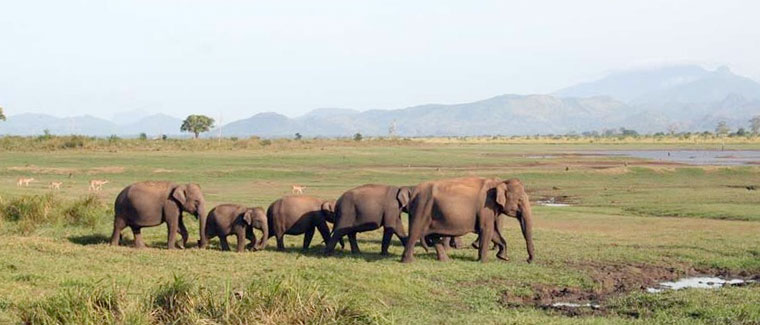
Except for Africa, Asia contains the greatest number of surviving megafauna species. The Asian Elephant herd in the image below resides in India.

With the great populations of the southern and eastern parts of this continent, the pressure on surviving species has been great. With the breakup of the Soviet Union, hunting has had an increasing impact on the large species surviving in the more sparsely populated north.

Although remaining natural landscapes are sparse, creation of protected wilderness lands in the warmer parts of Asia is crucial. As with Africa, relocation of
threatened species to the Americas will diminish the the probability that they will be wiped out through extinction in Asia.

Given the smaller human population, creation of wilderness areas in the north within the bounds of the former Soviet Union may be more feasible. Here we may even consider bringing back lost pleistocene species through cloning of frozen remains or modifying existing species through genetic manipulation to better survive in colder climes.


Europe


Europe is the most densely populated of all the continents. Like the Americas, most of its megafauna has become extinct. There have been attempts to recreate the Tarpan, the European wild horse, by breeding individuals who closely resemble the phenotype of the original animal. Two examples are the Konik horses of the Netherlands (portrayed in the image to the right) and the Heck horse of Germany. While genetically not the same animal as the original Tarpan, their outward appearance and manner is similar.

Unlike North America, there is little sparsely populated land remaining in Europe in which wilderness of adequate size could be created. The principal exception to this situation is eastern Europe where protected wilderness lands could be realistically envisioned. The lands downwind of the Chernobyl nuclear reactor, where a new wilderness has been spontaneously created, is one such example.


North America


 North America contains some of the most scenic and varied temperate habitats in the world. It ranges from arctic tundra to subtropical forest. The continent includes the uncommon cool rainforest of the North Pacific coast, California's coastal Mediterranean lands, the desert canyons of the Colorado Plateau, the high plains and prairies, and the vast forests covering much of the land east of the Mississippi River. The bison, most associated with the high plains, is shown to the left.

Of all the continents, the wilderness envisioned for North America is the most extensive. This is not because it is more deserving, but because we are most familiar with its habitat types and existing studies provide a solid foundation for wilderness location.

Although much of the eastern forest has regenerated in the past 100 years and many scenic areas are preserved in National Parks, the habitat is continually threaten by the sprawling and haphazard growth generated by the most powerful economy on earth. Significantly, a few habitat types exist in
contiguous areas of sufficient size to protect the viability of the resident plant and animal species.


Oceana


Oceana is defined here as including the mini-continents of Antarctica and Australia as well as most of the ocean islands not usually associated with a particular continent. Antarctica, with no permanent human inhabitants, is primarily a wilderness today. The only issue is whether its wildlife should be augmented with certain endangered species from the Arctic, such as polar bears and certain whales.

Australia has a population of about 20 million on a continent about the size of the mainland United States of America. Creation of future wilderness is clearly feasible. The fauna of that wilderness should probably be limited to marsupials native to Australia and nearby islands. The largest, the Kangaroo, is pictured here. Without careful evaluation, importing of more competitive mammals from other continents could be fatal to this relatively ancient mammal group.


South America


Guanacos in Torre del Paign National Park in Chile
South America lost most of its megafauna about the same time and probably due to similar causes as did North America. The habitat also has a breadth similar to that continent, with an emphasis in different areas. The guanaco, a relative of the camel, and native to both the altiplano and pampas, is shown to the left.

This continent contains the largest tropical rain forest in the world. It also contains deserts, plains and tundra environments, although at a much smaller scale than North America.

The Amazon rain forest is currently under attack by timber cutters, ranchers and poor farmers. On a trip to the Amazon in Ecuador, I experienced the negative impact on abundance of larger wildlife from hunting pressures in a 'protected' area.

Survival of linked rain forest wilderness extending over a wide assortment of tropical habitats and incorporating endangered species from the tropical areas of Africa and Asia is a vision.

Tuesday, November 12, 2019

Walkways and Stairs

The best way to experience and make sense of a city is by foot. An aerial view may help you comprehend the broad impact of a city on its environs,  but it fails to fully communicate what life is like for individuals living within its boundaries or suburbs. 

Walkways


Residents of America's cities and rural areas usually travel by car outside their home. Walking to a restaurant, grocery store, doctor's office and even a park is not the norm. The routes taken are usually fronted by single family homes of varying quality and interest. Seeing and actually talking to someone standing on the sidewalk (if there is one) is not a common experience. The front porch common 100 years ago seems to have disappeared, or if exists is vacant. Central cities are usually the only place where you frequently encounter people in the flesh or activity not related to home maintenance. Retirees taking a daily stroll on sidewalks bordering streets cutting through the neighborhood or kids playing in the front yard or street are the people most likely to break this pattern.

Italy


In the Italian images below can be seen "walkways" of a different sort which attract visitors from across the planet and, when tourist crowds diminish, support a relaxed lifestyle and strong community spirit.

Venice


Venice contains a wondrous multitude of walkways along and occasionally over its many canals. The Plaza of St Mark is frequently covered by masses of tourists drinking in the view across the waters of the grand canal and the buildings and statues defining the vast space. H. Graem © 2018


Florence 


Florence contains a market within a bridge spanning the width of the Arno River through which you might wander among the many stalls selling a variety of merchandise. Within the city one will find a more temporary market akin to the 'farmer's markets becoming more popular in American cities in recent times. H. Graem © 2018


Rome


Wandering through the Roman Forum was a favorite custom of Romans some 2000 years ago. Today's tourists get to enjoy a more truncated experience. The Spanish Steps are a favorite visitor hangout not entirely welcomed by current residents of the city. H. Graem © 2018

San Francisco


All is not lost in this land of my birth. Some California cities have created delightful walkway environments. San Francisco, the city an hour north of my home, has created walkways that are filled with a vibrant city life. Thankfully, other cities are becoming more aware of this need in their planning and evolving built places.

San Francisco's Chinatown neighborhood has wide sidewalks in certain areas. These images taken at dusk illustrate the neighborhood activity that can occur when people take advantage of the situation. On the left is a grocery store with certain goods set up for display on the sidewalk. On the left some local men are involved in some activity. Perhaps a game of chance? The right image finds a number of local musicians set up on the sidewalk in front of a restaurant to entertain passersby. H Graem © 2018

Stairs


Stairs can provide a wonderful addition to the experience of living and visiting a city. They have been an integral part of cities on hills since ancient times. They will be part of the city of the future as well. Stairs enable people on foot to move quickly and safely between nearby locations at different elevations. Stairs can provide one of the interesting physical details that make a city attractive and unique.

Spanish Steps in Rome, Italy. H Graem © 2018
The Spanish Steps in Rome, Italy are a famous example of city stairs. They were built in the early 1700s to traverse a steep slope linking the Spanish embassy on the Piazza di Spagna below with the Piazza Trinità dei Monti and the church of Trinità dei Monti above. They were designed by Francesco De Sanctis after generations of discussion over how the steep slope to the church should be developed.

The stairs are a popular Roman destination. This daytime activity fully demonstrates the popularity.


Attributes of Spanish Steps


What makes these stairs such a success and what can we learn from their attributes in the design of future stairs in other cities?
  • Design - They are designed as an urban asset that attracts urban residents and visitors. To achieve this goal they are carefully fashioned to (1) enhance their physical location and (2) respect the surrounding urban fabric.
  • Surroundings - A changing and interesting urban environment borders the stairs.
  • Solidly Built - They are built of solid materials (stone and high quality concrete are examples available today) that are easy to maintain.
  • Maintenance - As with so much that is beautiful in the urban environment, maintenance over time is crucial to continual success as an asset of the city. With their heavy use, even the stone Spanish Steps have been restored several times.
  • Connection - The stairs link nearby places people want to (1) walk to on an ongoing basis or (2) visit occasionally due to their character as a major attraction.
  • View - Stairs can be a place to view changing vistas of the city and its environs.
  • Landings - Landings exist on the stairs where (1) people may rest, (2) sit and enjoy the sun or (3) view the nearby surroundings.
  • Exercise - Stairs enable people to exercise their bodies in an appealing urban environment.

Telegraph Hill in San Francisco


Telegraph Hill Stairs
The stairways leading up Telegraph Hill to Coit Tower demonstrate favorable stair attributes in an American city. With the possible exception of design and maintenance for some of the stairs, all of the attributes mentioned above for the Spanish Steps are included.

The images to the left show the stairs up Telegraph Hill. The first two are stairs from the upper Grant street area of North Beach where the grade becomes too steep for a sidewalk alone. The last shows stairs ascending the east side of the hill above the Embarcadero.

Given the views common on the hills of the city and the gardens and homes bordering most stairs, even stairways to 'nowhere' receive heavy use, if not to get somewhere, at least to provide exercise for the ubiquitous joggers.

Whitby


Whitby Stairs, H Graem © 2006
This coastal stairway was encountered during a trip to Yorkshire in England during the summer of 2006. This stairway is located in Whitby on the coastal side of the North York Moors. The stairway connects the urban settlement along the harbor with the abbey. Beside those attributes mentioned above, this stair presents a ninth attribute of a successful urban stairway - convenience.

On the right is the stairway leading from the headland to the town of Whitby and its harbor. On the left below is the Abbey of the same name sited on the headland.

Whitby Abbey Ruins, H Graem © 2006
The stairway conveniently eases the way for visitors to the city. In Whitby, the summer tourist season finds parking a rare commodity in the lower city. However, the abbey ruins have a spacious parking lot for those willing to pay. The 199 steps provide a ready and scenic access for able-bodied abbey visitors to the city streets and restaurants.


San Jose's 'Tuscany Hills'


Southern San Jose, H Graem © 2020
The design of the stairs is grand in concept. The view from the stairs may not equal those visible from the actual hills of Tuscany, but it does present portions of the southern reaches of San Jose with the Santa Cruz Mountains appearing on the horizon. It does include seating at landings and the top of the stairs where people may rest and sit in the sun. The most significant attributes missing from this stairway are surroundings and connection.

Soon after stairs installed, H Graem © 2012
It is a steep and lonely climb. There is no changing urban scene bordering the stairs. There is just a formal garden mimicking the Tuscany stereotype, not the individuality associated with the actual Tuscan scene. The designers did not place buildings climbing up the hill parallel to the stairway to give a sense of closure and changing perspective as gardens grow and homes change.

Jogger starting up the stairs, H Graem © 2020
What will the intrepid climber find at the top to reward the effort? There is the view. Some hilltop parks have been completed. But there are not yet stores, restaurants, bars or coffee houses in the hillside community where the climber or jogger might rest, sip a brew or purchase items. There is not even a church to provide sanctuary comparable to the Trinità dei Monti on the plaza above the Spanish Steps. Although walking downhill with any purchases is preferable, there is not even the commercial magnet at the immediate bottom of the stairs for the resident of the hilltop community.

View from near the top of the stairs, H Graem © 2020
Hopefully, the community at the top will grow sufficiently large sometime in the future development phases to support street level stores, daycare or a coffeehouse. The original city plan contemplated such an urban environment. If not, will the opportunity for exercise by stairway joggers make up for the missing surroundings and urban connections? Time will tell.

View of Communication Hill with first phase of Tuscany Hills, H Graem © 2012
The image at the right gives a broad view of Communication Hill, on whose summit the 'Tuscany Hills' development is being constructed. The position of the stairs is indicated.

The tower sticking up at the top of the hill was constructed in the past to improve communication in 'Silicon Valley', thus the name of the hill.